Learning our lessons: Designing and implementing a workforce development program

Updated: Aug 11
Sara Hill, Ed.D
Origin story
At the tail end of the pandemic, when people could fly safely again, there was a swell of “pent up demand” in the aviation industry. People who couldn’t take their vacations or visit family for two years started flying again with a vengeance. The aviation industry, which had down-scaled during this period, had to quickly expand to meet the demand. This meant re-hiring to fill positions that had lost staff through buy-outs or other types of transitions. Finding qualified candidates for even entry level positions, however, was problematic.
Based on discussions with trainers and hiring managers in the industry, the difficulty that they were encountering to fill and train for these positions was several-fold:
The complexity of the airline business is such that competency is more difficult to achieve than in many other industries. That is, the skills needed are significantly higher than most entry level jobs.
Applicants are often ill prepared to join airlines, because they know little about the industry, and because other industries (tech, gaming, etc.) appear more interesting regardless of barriers of entry.
Once hired, workers are often lacking social skills that are just as important as technical skills, such as addressing conflict and effective communication.
The birth of Aviprep
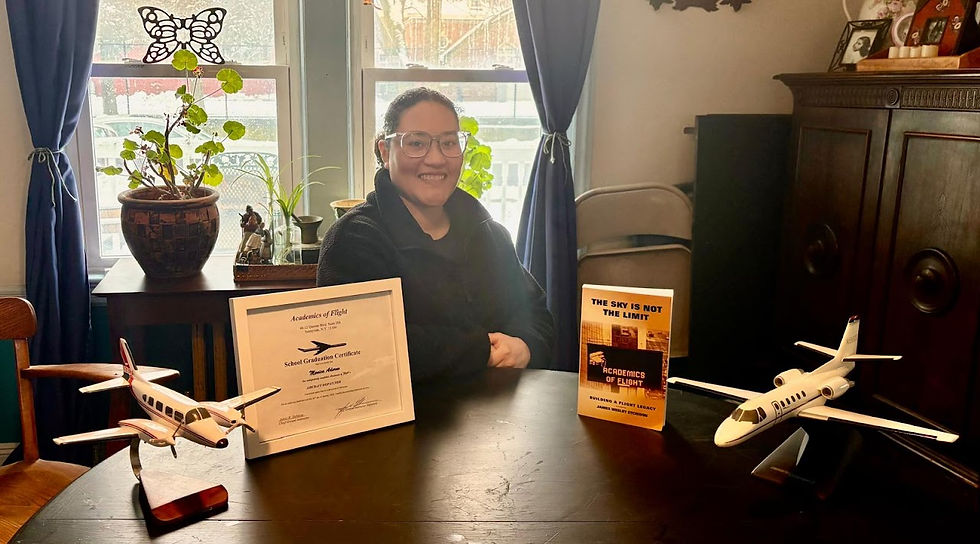
As a result of this need, we developed a 55 hour certificate program that targeted entry-level jobs in the aviation industry which do not require a BA but pay good starting salaries with opportunities for growth and full benefits (including travel benefits). We partnered with a small nonprofit organization, Hispanic Brotherhood, which applied for grants so that we did not have to charge tuition. We spread the word through state-funded employment agencies such as Hempstead Works, and other nonprofit networks.
We were awarded a grant through M & T Bank and we implemented 3 cohorts, (with a 4th cohort in October, 2026). Each cohort is composed of a maximum of 15 participants. They range in age from someone just graduated from high school with little to no work experience to someone who is switching careers at the age of 55. The majority of our students are working, however, they are in jobs that are either dead ends or do not provide enough to make ends meet. Participants work in jobs in restaurants, driving delivery trucks, working in retail for companies such as Home Depot. Several of our students have young families that increase their impetus to improve their employment situation. Our students are those who have been historically underrepresented in the aviation industry, including BIPOC individuals and women. The group meets in person on weekends, and participants receive a certificate of completion at the end of the 55 hour course.
Our curriculum
Our curriculum is a unique braid of skills to ensure students are well-rounded and prepared to succeed in all aspects of the job. As per our discussion with industry professionals and research in workforce development, training that focuses solely on technical proficiency neglects interpersonal dynamics critical for collaboration, problem-solving, and communication in professional settings. This is in spite of the fact that staff with strong social skills “can navigate complex team environments, engage in clear communication, and adapt to diverse workplace cultures, which enhances overall productivity and innovation” (Salas et al., 2015).
We intentionally designed our curriculum to incorporate a range of social skills, including active listening, managing conflict, working as a team and collaboration. In addition, we integrate job seeking skills such as writing a resume, creating online profiles, and interviewing using industry protocols (such as the STAR method). All of our lessons incorporate hands-on experiences as well as field trips to local airports and a local aviation museum (Cradle of Aviation) which provides a wealth of information about both the science of flight as well as the history of aviation. We also bring participants to visit a local airport where they are introduced to an aviation software app and are given a tour of the facilities including security and emergency services.
The curriculum covers STEM and technical aspects of the industry, including lessons on weight & balance, weather and meteorology, crew services and airport operation, and air traffic control. While none are exhaustive lessons, and we don’t expect our students to become experts, they provide participants with an advantage compared to other job candidates. Our graduates will have a much better understanding of the workings of an airline, and the underpinnings of technical skills and knowledge needed in jobs for which they are applying.
What we learned after 3 cohorts
After each cohort was completed, we engaged in an After Action Review. This allowed us to reflect on our experience as well as to review a range of data that was generated by a pre- and post-course evaluation. Based on the AAR, we adjusted our curriculum to respond to what we had observed as well as participants’ input. To date, we have identified some key learnings -- some of which we can respond to via our curriculum. Other obstacles stem from racial and economic inequality that is “baked in” which is often beyond our capacity to help. These inequalities make it extremely difficult for some participants to attend and complete the course (even though, in spite of big obstacles, most participants make it through. A testament to their courage and resilience). The following is an analysis of the major obstacles we’ve encountered with a few adjustments that might help in our upcoming cohorts.
OBSTACLES
Technology
When we surveyed Aviprep participants to determine who had computers (laptops or desktops), it turned out that at least half did not. We needed to use computers for several lessons, and luckily received funding to buy 15 laptops. When we asked students (who had them) to bring in their own computers for a lesson, their computers were often as not old and/or hadn’t been updated.
Because of their age, some students are not comfortable using computers. Interestingly, young students were just as limited in their use of computers as older folks because they primarily used their phones -- inadequate for tasks such as updating a resume. This meant we had to spend time in class to work individually with each student depending on their level of skill or the state of their technology. We are adjusting our expectations and providing students with a resume template which will be shared on Google Docs. This will alleviate the pressure to create a resume from scratch.
But technology is more than computers. This was brought home to us quite profoundly in our 3rd cohort. There was an unhoused mother and son who attended the cohort while living in a shelter. They had lost everything in a fire including critical documents that made it virtually impossible to apply for certain jobs. They were using a “burner” phone and sharing it between them. All of Aviprep's communication is done via What’sApp. WhatsApp did not recognize the students’ carrier, and it was extremely difficult to communicate unless we texted them and we never knew if they were checking their texts, or who was responding.
Transportation
Since our classes are held in the suburbs, we assumed that everyone had access to a car. This was not the case. In addition, some students had old and unreliable cars and struggled to afford gas. Public transportation is not the best alternative, as it is expensive and inconsistent, and getting to class early on a weekend made it even more challenging. We were able to arrange car pools for some students and one of the instructors would make a morning run to pick students up -- going out of his way to do so. Some of the students helped each other with rides, and we were able to use funds for students to take the bus or Long Island Railroad. This is something we will continue to offer in the upcoming cohorts.
Job seeking skills
Over the course of the three cohorts it became apparent that our students, at all levels of work experience, needed help with their job-seeking skills. Their resumes were in serious need of revision and there were often large gaps in their employment history which is an automatic red flag for an HR department. Students needed help articulating their skills and abilities (although they had skills and life experience in abundance). In one case, a student who worked for Verizon as a technician for over twenty years, and had never sought another position, was ready to move on. His interview skills during mock interviews were woefully deficient. We gave him a great deal of practice on and support for how to prepare for interviews and when he got a job at a company that maintains critical telecommunications systems for the FAA and Department of Defense, he told us that our interview practices were an important reason he got the job.
Other students were uncomfortable talking about themselves and needed help making connections between their work history and jobs in the aviation industry. A woman who ran a dog grooming business from her home wanted to get employment that wasn’t cash-based because she realized that she needed to pay into social security for retirement. We worked with her to articulate her transferable skills (e.g. organization and management) that could be applied to other types of jobs in the industry (NOTE: She is currently exploring becoming a dog trainer for the TSA).
In our future cohorts, we intend to spend more time having students a) articulate their current skills and abilities (whether in work or in their personal lives) and understand how these skills can be re-framed to align with skills required in their applications. Students will be given more help with their resumes, for example, providing explanations for gaps in their employment (e.g. taking care of an ill parent). In addition, we will spend more time preparing students for interviews, via practice and feedback sessions. Finally, we will have students practice public speaking, and, importantly, aquire and integrate industry specific vocabulary.
HR Departments
HR departments at both for-profit and non-profit organizations have taken a long time to recover from the pandemic. In fact, they still appear to be in disarray. Our students had experiences applying for jobs and a) never hearing back and/or b) were “ghosted” after interviews. They experienced their applications getting lost and background checks unfinished so they couldn’t move forward in a job application. These experiences created a sense of hopelessness and despair. We had to provide the students with a hefty dose of reality (e.g. providing them with an estimate of the number of applicants who apply per job posting), and how to use language in their applications that would trigger any AI scanning. But we mostly encouraged them not to give up and keep applying. Importantly, we were able to develop a relationship with the HR department of an airline, and alert them when our graduates were applying for positions. While the company didn’t automatically guarantee a job interview, flagged students were more likely to get an “assessment.” While this doesn’t help with the overall problem with HR departments (which are underfunded and understaffed) , developing these relationships can be an important step in supporting our students’ job-seeking.
Justice-Involved Students
Most jobs, especially those in transportation, require extensive ten year background checks. For those students who have been justice involved, this can be a major obstacle. This is especially true for those with felonies. Because we don’t screen for justice-involved applicants, we had at least three students over three cohorts with records. This made it extremely difficult for us to help them to apply and find work in a security conscious environment. In one case, one of our students had a felony record from 35 years ago. He had found work as a cabin cleaner through a third party vendor (companies hired by airlines to supplement services). He had gone through the training and had started the work, and had been pulled off the floor by customs and border patrol officers. He was unable to go back to work (although he is appealing it). Because of this experience, this student had a crisis, losing his sobriety and ending up in a rehabilitation program.
Over the course of the cohorts we learned about and began to partner with an organization that offers a second-chance program and have been referring students to them (Council for Airport Opportunities). In addition, we have become better at overtly communicating with students about how those with records may have difficulty finding work in jobs that require security checks. We are not excluding justice-involved students from our program because we feel that the skills that we do teach, such as SEL and job seeking skills, can be useful in a range of employment situations.
Emotional states & trauma
Based on our years of experience in community-based education, we assumed that social/emotional and community building activities would be key. We felt that this would be even more relevant for adult learners who may have been out of an educational setting for years. We incorporated playful icebreakers, time for discussion and reflection, and opportunities to share experiences and stories about each others’ lives. This lowered the “affective filter” to create an environment that allowed for enhanced learning. Our cohorts became very close to each other and continued their relationships with each other (and us) after the program had come to completion.
There were some students, that, for a variety of reasons, came traumatized and had serious emotional obstacles to pursuing work. In one case, a student who had gotten hurt on a previous job avoided applying for anything that might cause her further physical harm. In another situation, a student in his thirties who never had worked a job beyond working stock at a grocery store or working the register at Home Depot exuded lack of confidence, even down to how he walked. He never moved forward with any job application after competing the program. These are obstacles that we couldn’t help students with in a 55 hour certificate program, however, they are important to recognize and understand, and we need to perhaps adjust our expectations .
Volatility of the airline industry
First and foremost, all industries are dependent on the economy of the moment. With only a handful of exceptions, every sector is cyclical. Transportation, in particular, is dependent on factors such as the price of petroleum and how much discretionary money people have to spend on travel. That said, aviation isn't going anywhere. It is just as foundational to modern society as utilities or the internet—hardly a world we can picture functioning without.
So getting out students into the industry is the most difficult and important step. We tell our students that even if they are pushing wheelchairs initially, the career mobility is remarkably diverse and upward mobility, for someone who is ambitious, is quick. Once employed, participants can start out at the airport counter, transition into System Operations, earn an FAA license as a dispatcher or systems controller, and later pivot entirely into marketing, finance, or administration.
In some carriers, employees are able to request to shadow someone in a different division. This reflects well on them as motivated staff, and if/when openings come up in a different division, they can apply. Most carriers also invest heavily in their people through tuition assistance programs. If a participant if planning on studying in an aviation-related field (such as aircraft mechanics or business development), hands-on experience and FAA licenses can convert into college credits (depending on the college or university).
Summary
Following the post-pandemic surge in air travel, the aviation industry faced a severe labor shortage, struggling to fill entry-level positions due to applicants' lack of industry knowledge, shaky social/interpersonal skills, and the inherent technical complexity of airline operations. In response, Aviation Prep Academy was created, a grant-funded, tuition-free 55-hour certificate program. Targeting historically underrepresented groups, career changers, and low-wage workers, Aviprep blends foundational technical training (such as meteorology and flight weight/balance) with essential soft skills, hands-on field trips, and targeted job-search preparation to equip students for sustainable careers with upward mobility.
Throughout its initial cohorts, the program encountered systemic economic and social hurdles, including digital literacy gaps, unreliable transportation, lingering trauma, and rigid hiring protocols—particularly regarding justice-involved individuals or dysfunctional HR pipelines. In response, Aviprep adapted by providing hardware, integrating accessible tech templates, partnering with second-chance employment organizations, and directly liaising with airline HR departments to flag qualified graduates. Despite external structural barriers, the program demonstrates that combining comprehensive skills training with personalized support can effectively bridge workforce gaps and create viable pathways into the aviation sector.
Salas, E., Cooke, N. J., & Rosen, M. A. (2015). On teams, teamwork, and team performance: Discoveries and developments. Human Factors, 57(3), 514-529.

For any questions, please contact aviationprepacademy@gmail.com

link link link link link link link link link link link link link link link link link link link link link link link link link link link link link link link link link link link link link link link link link link link link link link link link link link link link link link link link link link link link link link link link link link link link link link link link link link link link link link link link link link link link link link link link link link link link link link link link link link link link link link link link link link link link link link link link link link link link